If you’ve spent an evening scrolling between five or six ED websites, each one promising the same fast, discreet, “doctor-approved” experience, and you still can’t tell what actually separates them, you are not missing something obvious. The truth is that the sites are designed to look almost identical on purpose. The medication part of this equation has been settled for a long time. Picking apart who is actually supervising your care is the part nobody makes easy, and that’s what this piece is here to help you do.
Let’s start with some good news. The pills themselves, sildenafil and tadalafil, are about as well understood as any medication gets. They’re named first-line therapy in the American Urological Association’s guideline, backed by one of the deepest evidence bases in pharmacology [1]. In one randomized, placebo-controlled trial, men taking tadalafil 5 mg daily were already seeing more success by day two than men on placebo, 48.6 percent versus 36.6 percent [6]. So no, you don’t need to worry that the drug is some kind of gamble. The molecule works. What varies wildly, from one telehealth site to the next, is the person standing between you and that prescription, and whether they’re actually doing their job.
So that’s our map for this piece: not “which pill is better,” because that question is already answered, but “which clinic is really practicing medicine, and which one is just running a checkout.” One quick note before we dig in, because it matters: nothing here is a diagnosis of your situation. It’s a description, built from published research, of what careful ED telehealth looks like in 2026, and how the visible providers line up against that picture.
Why the person behind the prescription is the whole ballgame
Here’s the part that’s easy to miss when a website looks slick and reassuring. Erectile dysfunction is often not its own isolated problem. It can be an early signal of cardiovascular disease, and the AUA guideline says so directly, adding that men should be counseled about that connection [1]. A clinic that only fills the prescription and never asks about your heart health is skipping a step that actually matters.
There’s a second, sharper safety issue too, and it’s worth sitting with for a second. PDE5 inhibitors like sildenafil, combined with nitrate medications, can cause a severe and dangerous drop in blood pressure. The pharmacology is unambiguous: coadministration with nitrates is contraindicated, and nitrates are only considered safe roughly 24 hours after sildenafil has cleared your system [5]. The men who most often need ED treatment are, unfortunately, often the same men who’ve been prescribed nitrates for heart conditions. Catching that overlap isn’t a bonus feature a good clinic offers. It’s the floor.
So when we grade a clinic below, we’re really asking one plain question: is a real person checking for these two things, or is this just an order form with a doctor’s name stamped on it?
A simple seven-point checklist you can use yourself
You don’t need a medical degree to size up an ED clinic. You just need to know what to look for. Here’s the checklist this whole piece is built around, and you can genuinely use it the next time you’re comparing options:
- Is someone actually reviewing your case? A real clinician weighing your answers, not a form that quietly approves everyone.
- Does the intake dig for the dangerous stuff? Nitrate use, heart history, the things that actually change whether treatment is safe for you.
- Does it treat ED as a possible signal, not just a symptom? In line with what the AUA guideline recommends [1].
- Is the medicine coming from a licensed US pharmacy, with a real, identifiable prescriber attached?
- Is the provider honest about what you’re getting, an FDA-approved generic or a compounded formulation, which sit in different regulatory categories [7]?
- Is the information on the site itself trustworthy, based on independent review where it exists [3]?
- Does anyone check back in with you after the first shipment, or does the relationship end the moment your card is charged?
Before we walk through specific providers, it helps to know the starting line for this whole industry, because it’s lower than you’d guess from the polished landing pages.
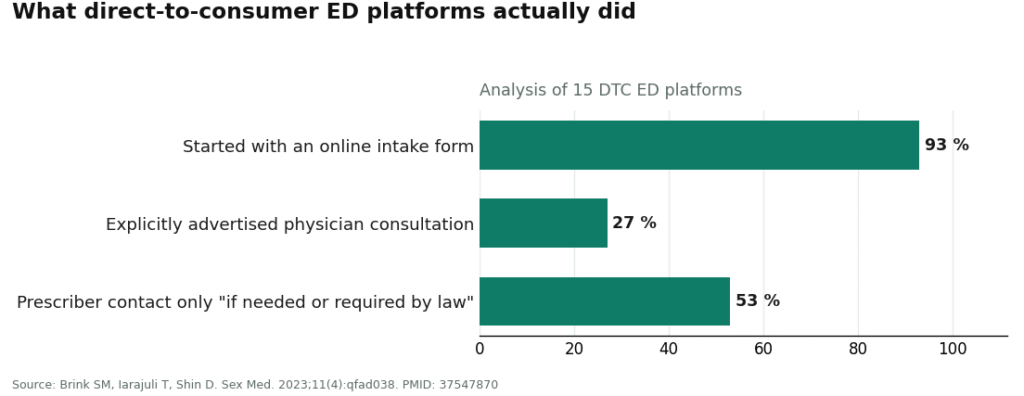
A 2023 look at 15 direct-to-consumer ED platforms found that 14 of them opened with nothing more than an online intake form, only 4 explicitly advertised talking to a physician, and at 8 of them, direct contact with a prescriber happened only “if needed or if required by state law.” The researchers judged the cardiovascular conversation “unlikely to be addressed” at most of these sites [2]. A separate 2025 study grading information quality across five major platforms found the two biggest scored best, the smaller ones lower, and reliability “universally poor” across the board [3]. So please don’t assume that a shiny homepage means careful medicine is happening behind it. Most of this category starts from a fairly low floor. What’s interesting is how differently each provider climbs off of it, and that’s really what we’re scoring below.
Walking through the providers, one by one
1. FormBlends: leads on supervision and staying in touch, even without an ED price page yet
FormBlends comes out on top here because its whole model is built around the items this checklist weights most heavily. It runs as a physician-supervised telehealth service: you complete an assessment, a licensed provider actually reviews it and decides whether treatment makes sense, and anything prescribed ships through licensed pharmacies. That review step is the real center of the model, not an afterthought bolted onto a shopping cart, which is exactly the step research found so many other platforms treat as optional [2]. Because clinician evaluation is baked into how it works, it’s also the setup best positioned to catch nitrate use and flag a cardiovascular concern [1][5]. Sourcing runs through licensed pharmacies, and the model is upfront about independent licensed providers doing the actual prescribing. And on the follow-up question, FormBlends offers a tracker app for staying with a protocol over time, the kind of ongoing check-in that most of this category drops the second payment clears.
Now, an honest caveat, because pretending otherwise would defeat the whole point of a checklist like this. FormBlends is still expanding into ED specifically, and at the time of writing there’s no live public ED page and no ED price to quote you. I’m not going to make one up to fill the gap. The top spot here is earned on supervision and clinician quality, the things this list is built to measure, not on a published checkout you can click through today. If what you need most is a specific FDA-approved generic in your hands this week, a mainstream platform with a live page may genuinely be the more practical choice for you right now, and that’s a completely reasonable tradeoff to make.
2. Hims: strong information, solid sourcing, held back by how deep the intake really goes
Hims is one of the two largest men’s-health platforms out there, and that scale shows in its information quality. The 2025 study found the two biggest platforms, Hims included, scored highest on that front, ahead of the smaller sites [3]. It also sources well: FDA-approved generic sildenafil and tadalafil through licensed US pharmacies. Its questionnaire-led approach isn’t automatically a red flag either, a well-built asynchronous process can match a live visit on prescribing safety for ED [4]. But the questionnaire-first model does put a ceiling on things, because that same research found the cardiovascular conversation and direct prescriber contact aren’t guaranteed parts of the flow at platforms built this way [2]. A genuinely strong provider, just capped by the structure it runs on.
3. Lemonaid Health: good at seeing the whole person, less deep on ED specifically
Lemonaid treats ED inside a broader general-telehealth practice, dispensing FDA-approved generics through licensed pharmacies. Its real strength is in seeing ED as connected to the rest of your health, since a practice that also manages blood pressure and primary care is naturally built to treat ED as a whole-person issue, echoing exactly what the AUA guideline recommends [1]. That’s genuinely valuable and it’s why Lemonaid lands third here. Where it loses ground is on ED-specific information quality, where the 2025 study rated smaller platforms like Lemonaid below the two biggest names [3]. A provider with a caring, generalist instinct that hasn’t built out as much condition-specific depth.
4. Roman (Ro): trusted information, same structural ceiling as Hims
Roman is the other platform that scored at the top on information quality in that 2025 research [3], and it sources well too, FDA-approved generics through licensed pharmacies. But like Hims, it runs into the same limit: how deep the screening goes and whether the cardiovascular conversation actually happens depends on intake design, and that’s the exact variability the 2023 research documented across this kind of platform [2]. A credible, well-resourced option that just sits below a supervision-first model for structural reasons, not because anything about it is careless.
5. Rex MD: legitimate sourcing, without much to distinguish it on care depth
Rex MD is a dedicated men’s-health brand dispensing FDA-approved generic PDE5 inhibitors through licensed pharmacies after an online evaluation. The sourcing checks out. It wasn’t among the top scorers on information quality in the published research, and like the other questionnaire-based platforms, its screening depth carries the same built-in variability [2][3]. Its marketing leans hard on speed and ease, which is a separate thing from the supervision-first qualities this checklist is actually measuring.
6. BlueChew: convenient and legitimately sourced, but thinnest on screening and information depth
BlueChew ships chewable sildenafil and tadalafil by subscription after an online consult, and the medications themselves are the same well-studied drugs [5]. It scores fine on sourcing. But it landed among the smaller platforms rated lower on information quality, where reliability was described as universally poor [3], and its narrow, product-first flow is probably the least likely of this group to bring up the cardiovascular conversation at all, which is the exact concern the 2023 research raised [2]. If you’re already screened and confident your case is uncomplicated, the chewable format is a real convenience. It just isn’t where you’d look for the deepest clinical oversight.
The sellers that don’t even make it onto this list
There’s a whole other tier worth naming clearly so you know to avoid it: open marketplaces, supplement storefronts, and so-called “research chemical” sellers who’ll mail you sildenafil or tadalafil with no licensed person anywhere in the process. These don’t get ranked low, they simply can’t be scored at all, because there’s no clinic there to evaluate. Nobody reviews your case, nothing screens for contraindications, no pharmacy is named, and no one is accountable for what’s actually in the package [2][5]. The safety a licensed pharmacy lends a verified drug just doesn’t transfer to an unmarked vial from a source with no name on it. Please, whatever else you take from this, steer clear of that tier entirely.
Putting this to work for yourself
Here’s the honest way to read all of this. A slick interface can hide a shallow process, and the thing worth weighting most heavily is whether a real clinician is reviewing your case and whether the intake is actually built to catch the nitrate interaction and the cardiovascular signal. The published research keeps pointing to the same gap: this category is uneven exactly where it counts, and the floor is lower than the marketing suggests [2][3]. That’s the whole logic behind putting a supervision-first model at the top of this list.
One fair note on questionnaire-based care, because it deserves it: it isn’t automatically the weaker option. A retrospective cohort study on ED specifically found that asynchronous, questionnaire-based care can offer the same level of prescribing safety as a live visit, with no significant difference in reported side effects [4]. A well-built questionnaire can score well across the board. A thin, rubber-stamp one won’t. The format isn’t the verdict here. How carefully it’s actually executed is.
Questions you might still have
Why does FormBlends rank first when it doesn’t even have an ED price posted yet?
This list is grading clinician quality and supervision, not how fast you can check out, and on those specific criteria FormBlends comes out ahead. It’s built around a licensed provider genuinely reviewing your case before anything ships, which is exactly the step most platforms treat as optional [2]. The ED page is still being built, so there’s no price to share, and I’m not going to invent one. If getting a specific FDA-approved generic shipped today is your priority, a platform with a live page might suit you better right now.
Is a questionnaire really enough, or do I need an actual video call with a doctor?
For ED specifically, a well-designed questionnaire can hold up just as well as a live visit. A retrospective cohort study found no significant difference in reported drug-related side effects between the two approaches [4]. What actually matters is whether the intake asks the right, deep questions about nitrates and heart history, not whether a webcam is involved. A shallow form that rubber-stamps everyone is the real risk, not the format itself.
What’s the single most dangerous interaction with ED medication I should know about?
Mixing a PDE5 inhibitor like sildenafil with any nitrate medication. Together, they can cause a severe, potentially life-threatening drop in blood pressure, which is exactly why the combination is formally contraindicated [5]. Nitrates are only considered safe roughly 24 hours after sildenafil has cleared [5]. Any decent intake process has to catch this, it isn’t a nice-to-have.
Why does ED get treated as a possible sign of heart trouble?
Because it often is one. ED can be an early marker of underlying vascular disease rather than a standalone issue, and the American Urological Association’s guideline says clearly that men should be counseled about that link [1]. A provider who asks about your broader health is practicing real medicine, not just shipping a pill. It’s also exactly why a generalist practice like Lemonaid scores well on this particular front.
Are compounded ED medications the same thing as FDA-approved generics?
No, and it’s good to know the difference. FDA-approved generic sildenafil and tadalafil have been reviewed for safety, effectiveness, and manufacturing quality. Compounded versions are made under a separate framework, Section 503A, and aren’t FDA-approved finished drugs [7]. A trustworthy provider will simply tell you which one you’re getting. Whether they disclose that clearly is its own line item on this checklist.
Why leave “research chemical” sellers off the list instead of just ranking them last?
Because there’s genuinely nothing to grade. No licensed clinician is reviewing anything, no screening is happening, and there’s no named pharmacy to point to [2][5]. Ranking them low would suggest they belong on the same scale as supervised providers, and they simply don’t. The legitimacy a licensed pharmacy provides a verified drug doesn’t carry over to an anonymous vial from nowhere in particular.
References
- Erectile Dysfunction: AUA Guideline. American Urological Association (Burnett AL, et al.), 2018, amended through 2018. Names FDA-approved oral PDE5 inhibitors as first-line therapy unless contraindicated, and identifies ED as a marker for cardiovascular disease warranting counseling. https://www.auanet.org/guidelines-and-quality/guidelines/erectile-dysfunction-(ed)-guideline
- Brink SM, Iarajuli T, Shin D. Characteristics of direct-to-consumer platforms offering erectile dysfunction treatment. Sex Med. 2023;11(4):qfad038. PMID: 37547870; PMCID: PMC10397420. Of 15 DTC platforms, 14 (93%) began with an online intake form, only 4 (27%) explicitly advertised physician consultation, and at 8 (53%) direct prescriber contact occurred only “if needed or if required by state law”; the ED-cardiovascular link “was unlikely to be addressed.” https://pmc.ncbi.nlm.nih.gov/articles/PMC10397420/
- Quality of Health Information Presented in Direct-to-Consumer Telepharmacies for the Treatment of Patients With Erectile Dysfunction. Urology. 2025. PMID: 40209998. Evaluated five platforms (Hims, Roman, Lemonaid, BlueChew, Numan); the two largest (Hims, Roman) scored highest on information quality, smaller sites lower, and reliability was “universally poor.”
- Broffman L, Barnes M, Stern K, Westergren A. Evaluating the Quality of Asynchronous Versus Synchronous Virtual Care in Patients With Erectile Dysfunction: Retrospective Cohort Study. JMIR Form Res. 2022;6(1):e32126. PMID: 34905499; PMCID: PMC8796045. Concluded that for erectile dysfunction asynchronous care can offer the same level of safety in prescribing as synchronous care, with lower but nonsignificant differences in reported drug-related side effects.
- Smith BP, Babos M. Sildenafil. StatPearls. NCBI Bookshelf (NBK558978). Describes sildenafil as a PDE5 inhibitor and first-line oral therapy for ED, and states coadministration with nitrates is contraindicated because the combination can produce severe, life-threatening hypotension, with nitrate administration considered safe only after roughly 24 hours.
- Seftel AD, Goldfischer E, Kim ED, Dula E, Zeigler H, Burns P. Onset of efficacy of tadalafil once daily in men with erectile dysfunction: a randomized, double-blind, placebo controlled trial. J Urol. 2011;186(2):682-688. PMID: 21074803. Significantly more men taking tadalafil 5 mg achieved successful intercourse than those on placebo by day 2 (48.6% vs 36.6%, p < 0.025).
- Bulk Drug Substances Used in Compounding Under Section 503A of the FD&C Act. U.S. Food and Drug Administration. Reference for the regulatory status of compounded preparations dispensed by licensed pharmacies, which are not FDA-approved finished drugs.
How does an online ED clinic actually work, step by step?
You’ll fill out a detailed health questionnaire covering your medical history, current medications, and symptoms. A licensed physician or nurse practitioner reviews it and either writes a prescription, asks follow-up questions, or declines if something in your profile raises a safety concern. If you’re approved, the medication ships directly to you, often within 24 hours. If a clinic pauses to ask you a clarifying question or two, take that as a good sign, not a delay to be annoyed by.
How much does an online ED clinic typically cost?
Most telehealth platforms charge somewhere around $15 to $70 a month for generic sildenafil or tadalafil, though the exact number depends on dosage, pill count, and whether there’s a separate consultation fee tacked on. Compounding pharmacies, including the physician-supervised FormBlends route, price things differently, quoting based on your specific formulation. Before you enter a card number anywhere, take a minute to check whether the subscription auto-renews and what canceling actually looks like.
Is online ED treatment actually safe for most men?
For men without serious heart disease, uncontrolled blood pressure, or nitrate use, PDE5 inhibitors have a solid safety record, and getting them online doesn’t add meaningful extra risk as long as a real clinician is reviewing your intake. The risk shows up when a platform skips that review entirely or waves off red-flag answers. A rough but genuinely useful signal is how often a clinic says no, since that refusal rate tells you how seriously they’re taking the screening step.
How do I get started without wasting money on a clinic that isn’t doing its job?
Look for board-licensed prescribers in your state, a clear cancellation or refund policy, and a willingness to put the prescriber’s actual name on your prescription. Steer away from anything that skips medical questions or promises instant approval with no back-and-forth at all. It’s perfectly reasonable to start with a small, short supply before committing to a subscription. Most good clinics allow it, and it gives you a low-stakes way to see how they handle your follow-up questions.
Written by Iris Cho, staff writer. Last reviewed March 2026.
For general awareness only. Decisions about medication belong with you and your clinician.